World Flow Tech — Urban-signal infrastructure
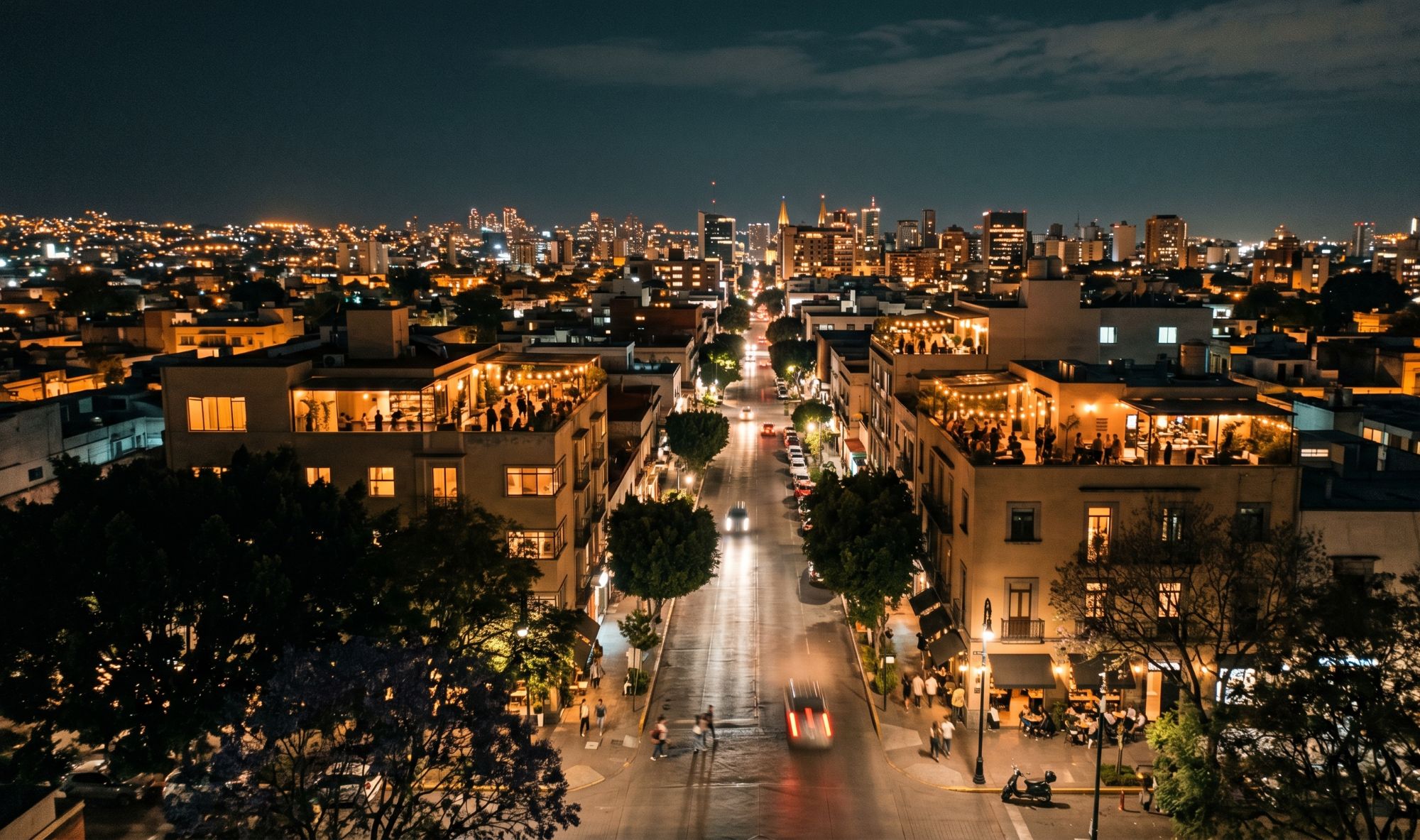
Every night, a city like Guadalajara breathes through thousands of bodies.
Talk to the teamThey walk into a bar, hear three songs, decide to stay or leave. They cross the street and decide again.
That breath leaves traces — tabs at the bar, tips on the table, broken glasses, cabs ordered at odd hours — and yet no legible record. The night economy remains, at its richest layer, a conversation between strangers the city never overhears.
The systems that claim to represent it, maps, reviews, rankings, arrive late to a conversation that has already moved.
What World Flow Tech does begins in that asymmetry, between the actual presence of people and the silence of the infrastructure meant to read them.

A structural asymmetry
The physical market for hospitality still operates, even today, without real-time information. Every night, considerable volumes of spending, attention, and social energy move through it. Venues compete for a demand no one measures while it happens.
Independent operators — owners of bars, salons, rooftops, cultural spaces — work on intuition against algorithmic platforms that weigh more than they understand. International visitors arriving in a Mexican city orient themselves with reviews that age in weeks and maps that confuse historical popularity with present life. Tourism secretariats finance annual campaigns with no mechanism to verify what that demand finds once it lands.
Seen from any of the three sides, the asymmetry is not cosmetic. It is structural.
World Flow Tech builds urban-signal infrastructure — a data layer that lets a city's nocturnal physiology be read as it happens, not weeks later in a report.
Scannivibe is the first operational expression of that thesis: the product that closes the loop between physical presence and structured record, and a window into the larger capacity the company builds quietly.
The company is born with an ear in the institutional ecosystem, where it sits as a listener in the JICA-MakerCenter circle, and with a team whose technical record distinguishes the construction of one more feed from the construction of urban instrumentation.
Scannivibe
The unit of capture is deliberately simple. Every venue displays a QR code at the door or on the table. The visitor scans it with the phone's native camera, downloading nothing. They declare their state in two taps — how they arrive, what they are looking for, the energy they bring — and receive the venue's Vibe Score in under ten seconds.
What for the visitor is a three-second gesture is, for the data layer, something else: a precise row, a verifiable timestamp, a stable coordinate, a behavioural signal that folds into the aggregate without surfacing the individual.
Three simultaneous layers rise on top of that unit.
For the operator, the dashboard stops being a weekend curiosity when a number arrives that confirms what last Tuesday was only intuition: that the rooftop fills the first two hours but loses people before midnight, that the corridor across the street pulls flow after one, that Wednesday night has a different shape than Thursday.
For the visitor, the scan feels different. It is neither transaction nor metric of digital engagement: it is a gesture of presence, a way of saying I am here that the city can finally receive.
- 01
Mood
The individual state with which each person crosses the door
Captures, in two taps, how each visitor arrives and the energy they bring. Each declaration is a precise row, with timestamp and coordinate, that folds into the aggregate without surfacing the individual: the behavioural raw material everything else rises on.
- 02
Vibe
The living composition of the venue at that exact moment
Composes the venue's Mood signals into a portrait of the moment: how full it is, what energy circulates, who else chose to be there. Gives the operator a number that confirms what before was only intuition — like the rooftop losing people before midnight.
- 03
Pulse
The city read as an active network, not a map
Aggregates every venue's Vibe into the nocturnal physiology of the city: which neighbourhoods stay active, where the flow migrates between eleven and two, which corridors connect on their own. The layer that serves operators, tourism, and urban planning.
The World Cup as accelerator
FIFA 2026, hosted by Mexico together with the United States and Canada, functions in this thesis as accelerator, not bet. The matches matter less than the legacy they leave — the structural visitor flows that persist after the trophy has changed hands and the lights have dimmed.
Mexico will receive, during the tournament and in the years that follow, an international demand current with no precedent of comparable scale in the region. A current that pulls airlines, hospitality, restaurants, and night life along with it, and that reconfigures urban corridors faster than traditional tourism planning knows how to answer.
Scannivibe enters that window with working product, an active book of venues in conversation, and a field team on the ground in Guadalajara, with activation under way toward Monterrey, Ciudad de México, Cancún, and Puebla.
The hypothesis is not that the tournament produces revenue on its own, nor that the event is the hook. The hypothesis, more sober, is another: the structural flows the tournament catalyses create a sustained surface of demand. Against that surface, a data layer like this can scale with reason.
Building before the tournament means arriving after with instrumentation installed in venues that already operate, not with presentations or with promises of coverage.

A bicontinental company
World Flow Tech operates as a single organism distributed across two continents. The holding company is registered with UK Companies House under number 16871957, incorporated in November 2025. It is the base of intellectual property and the entity that signs institutional agreements and funding rounds.
The Mexican S.A.P.I. de C.V., in the process of being constituted between June and July 2026, will be the local operating vehicle. It is the legal form that signs with venues, receives payments in pesos, and sits at the table with secretariats and chambers of commerce when those conversations arrive.
The technical team operates from Chile as direct contractor — a decision that answers to talent quality and time zone. The roadmap extends into Colombia in the last quarter of 2026 and into Peru in the first of 2027, a sequence that follows the actual geography of Latin American night life, not the abstract list of large markets.
The company is bicontinental by design, not by accident of founding. Its thesis about the urban was born from inhabiting two cultural languages at once: the neighbourhood you walk without thinking and the neighbourhood you learn street by street.
From that double residence comes an operational conviction: a data infrastructure like this needs, from day one, more than one way of looking at the city — so as not to collapse into one alone.
The company keeps academic roots at Friedrich-Schiller-Universität Jena that inform its reading of European public space. Added to that European reading is an interest expressed by actors in the cultural ecosystem of Jena — an interest the company receives with the sobriety appropriate to a conversation still young.
A civic archive of night
The company's long horizon is best seen from a distance. What accumulates, scan after scan, is verified presence — and verified presence has value in itself, before any market gives it a name. Each row is a piece of evidence with coordinate, time, and behavioural context, irreducible to vanity metric.
Sustained over months, then years, then geographies, that accumulation ceases to be a database. It begins to resemble something else: a civic archive of how night breathes — in cities that until now could only tell themselves through annual surveys and conjecture.
A layer of that kind has natural consumers. Urban planning, which today decides with information five years old. Public policy, which regulates night life without ever having read it up close. Academic urban research, which studies public space with the instruments academia had at hand before instruments like this existed.
What those three worlds will ask for, sooner or later, is not one more metric. It is a data layer that sustains itself over time and lets itself be read across cities.
The thesis is operational, not speculative. The task is to build, today, the instrumentation that records urban physiology at its smallest scale — the venue — and to sustain it with discipline enough that in five years there exists an archive the city recognises as its own. Each scan this week is an entry in that archive.
The conversation
The conversation is already open. If what is described here aligns with an investment mandate, with an institutional programme, or with the operation of a city that measures itself up close, writing is enough.